
Paris 2024 will be the 17th edition of the Paralympic Games. Since they were first held in Rome in 1960, much has changed since that first event, in which around 400 athletes from just 23 countries took part and with only eight sports on the programme.
4,400 athletes with physical, intellectual, visual, and paralysis or brain injury disabilities from 182 countries will compete in the French capital. Although the number of athletes is the same as at the Tokyo Games, there will be important changes in the distribution by sport, with the aim of increasing female participation, protecting athletes with greater disabilities and equalizing the quotas in team events.
THE SPANISH DELEGATION IN PARIS 2024 WILL BE MADE UP OF AROUND 140 PARALYMPIC ATHLETES
In total, 549 medal events (of which 271 are men’s, 235 women’s and 43 mixed) will be contested across the 22 sports on the Paralympic programme: athletics, badminton, wheelchair basketball, boccia, cycling, wheelchair fencing, 5-a-side football, goalball, judo, weightlifting, equestrian, swimming, canoeing, rowing, wheelchair rugby, taekwondo, table tennis, wheelchair tennis, archery, shooting, triathlon and sitting volleyball. There will be no new sports compared to the previous Games in Tokyo.
The president of the Spanish Paralympic Committee, Miguel Carballeda, recalls that there are 4.5 million people with disabilities in Spain and underlines “the value of sport, which makes those with a disability feel valid and capable.”
“Our obligation at the Spanish Paralympic Committee is to win medals, but there are other important things in life, such as knowing how to go for it, representing the Spanish team with dignity and those 4.5 million people with disabilities,” Carballeda said.
Spanish delegation
The Spanish Paralympic Committee estimates that around 140 athletes will compete, around 125 with disabilities and 15 without disabilities, including pilots and guides. The Spanish delegation will be completed by 90 more members, including coaches, doctors, physiotherapists, mechanics and support and office staff.
In total, up to 13 Spanish sports federations may provide participants for Paris 2024. In addition to the four that group athletes according to their type of disability – for the Blind (FEDC), People with Physical Disabilities (Feddf), People with Intellectual Disabilities (Feddi) and People with Cerebral Palsy and Acquired Brain Damage (Fedpc) – there are the Spanish Federations of Badminton (Fesba), Rowing (FER), Triathlon (Fetri) and Taekwondo (RFET), and the Royal Spanish Federations of Cycling (RFEC), Canoeing (RFEP), Tennis (RFET), Table Tennis (Rfetm) and Archery (Rfeta), the latter as a result of the process of integrating sports for people with disabilities within Spanish sports federations.
The main objective of the Spanish delegation will be to equal or surpass the 36 medals won in Tokyo 2020 (9 gold, 15 silver and 12 bronze) in seven sports: athletics, cycling, judo, swimming, table tennis, triathlon and shooting. In addition, 131 diplomas were obtained. With these results, Spain is in fifteenth place in the medal table.
Athletics
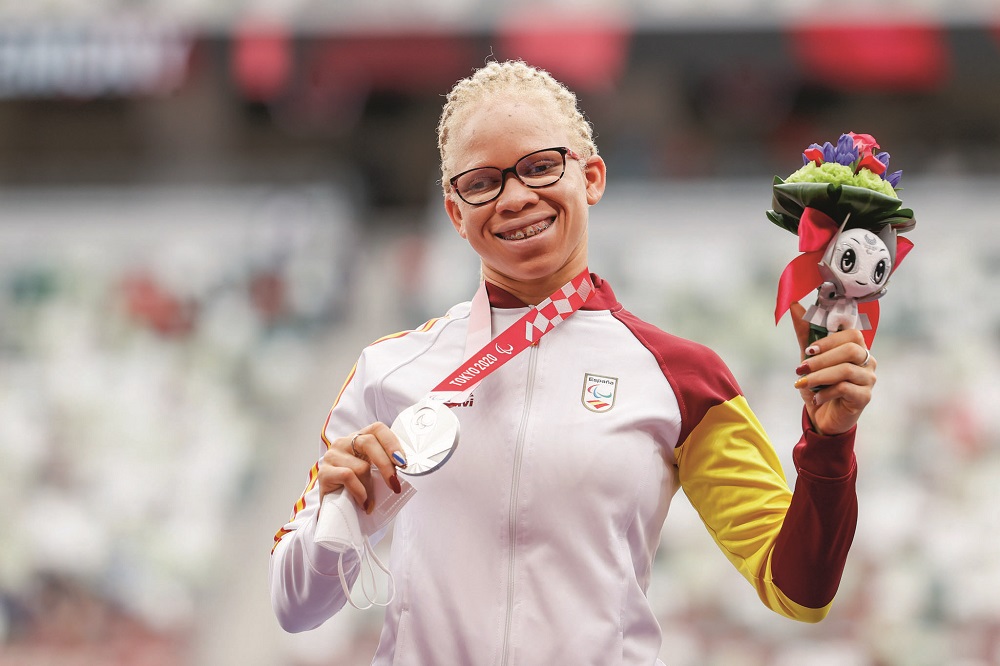
One of the great assets of the Spanish delegation will be in athletics. In this sport, many eyes will be on Adiaratou Iglesias, current Paralympic champion in the 100 metres T13 (athletes with visual impairments) in Tokyo 2020.
Iglesias was already the breakout athlete for the Spanish Paralympic Team at the last Games, where she made her debut with a gold medal in the 100 metres and a silver in the 400 T13. The athlete born in Mali and raised in Lugo has also achieved a champion title and a runner-up title at the 2023 Paris World Championships.
Adi Iglesias’ goal “is to achieve the same results as in Tokyo, that is, the gold medal. I think I am training very well for it, and my toughest event is the 100m, where I want to give it my all, and, of course, also do it in the 400m. In addition, these games will not be marked by Covid-19, as in Tokyo, so I will enjoy them 100%,” he says.
Other notable Spanish athletes include long-distance runner Yassine Ouhdadi and sprinter Gerard Descarrega.
Judo
Marta Arce will be fighting for her fourth medal on the tatami. The 46-year-old from Valladolid will compete in her fifth Paralympic competition. “The Games are the most important event that an athlete can aspire to and I hope to enjoy them very much first of all, and secondly, to do well. Results are important, but the most important thing, personally, is to have a good competition, some good fights.”

Arce, who is visually impaired and is also a mother of three children, will try to get on the podium, as she did at the Athens 2004 and Beijing 2008 Games, winning two silver medals and one bronze at London 2012.
Swimming
One of the Spanish delegation’s greatest assets in winning medals will be swimming, a sport in which they won fourteen medals in Tokyo (two gold, nine silver and three bronze).
Teresa Perales will compete in the pool, pr Princess of Asturias Award for Sports 2021 and who is the Spanish athlete with the highest number of medals at the Games, with a total of 27 (seven gold, ten silver and ten bronze), obtained in the last six Paralympic editions (Sydney 2000, Athens 2004, Beijing 2008, London 2012, Rio 2016 and Tokyo 2020).
Other Spanish medal hopes include Sarai Gascón, winner of nine medals in five participations; Nuria Marqués, with four medals; Marta Fernández, the most decorated Spanish athlete in Tokyo with a gold, a silver and a bronze; Toni Ponce and Anastasiya Dmytriv, aged just fifteen.
From swimmer to cyclist
 A notable case is that of Ricardo Ten, who decided to abandon swimming after the 2016 Rio Paralympic Games, with seven medals under his belt, and start his career in cycling. Ten has a physical disability, due to an electrical accident he suffered when he was eight years old and which caused him to lose both arms and one leg, and since then his life has been linked to Paralympic sport.
The now cyclist says he is “very excited about these seventh games because the cycle has been very good.” He says that he is “very uncertain about the athletes who only appear during the games like the Russians, but we are going to arrive in good shape and we hope for the best by focusing on the time trial.” Finally, he points out that he will fight “to be on the podium.”
weightlifting

In weightlifting, Loida Zabala, who was diagnosed with cancer in October, has explained that sport is “a lifeline” for her. “Before, when I saw Paris 2024 I saw it as an opportunity to win a medal, that it would be my first Paralympic event, but now when I see that logo it reminds me that I am still alive and that I still have the opportunity to enjoy myself while working to fulfil my dreams,” she emphasises.
Cycling
In cycling, Alfonso Cabello from Córdoba, champion in Tokyo 2020 in the kilometre race, and Sergio Garrote, who after suffering a work accident that caused paraplegia, decided to try cycling and won two medals (gold and silver) in the last Games, also have a chance of winning a medal.
Other stars of Spanish Paralympic sport include Susana Rodríguez, Eva Moral and Daniel Molina (triathlon), Álvaro Valera (table tennis), Juan Antonio Saavedra (shooting), Martín de la Puente (table tennis) and Judith Rodríguez (fencing).
Ceremonies and venues
The opening ceremony will take place on 28 August. It will be a parade down the Champs-Élysées ending at the Place de la Concorde, with thousands of fans from around the world cheering on the Paralympic athletes through the streets of Paris.
The Games will feature 17 competition venues, spread across the city centre (nine venues) and the Saint-Dennis area in the north (three). The other five are located in the outskirts or in nearby towns.
THE PARALYMPIC GAMES WILL BE BROADCAST TO 170 COUNTRIES WITH AN AUDIENCE OF 4.2 BILLION PEOPLE
Some emblematic monuments of the French capital, such as the Eiffel Tower, the Champ de Mars, Invalides and the Palace of Versailles, will be the scene of the Paralympic events. The opening ceremony will take place in the central Place de la Concorde, with the national delegations parading down the Champs-Élysées. The closing ceremony, scheduled for 8 September, will be held at the Stade de France in Saint-Denis.
One notable fact is the growing interest in Paralympic sport, as shown by the increase in broadcasts of the Games around the world. In Paris, more than 2,200 journalists from around the world will report on the exploits of the best disabled athletes for the whole world. On the Spanish side, some 60 Spanish journalists representing some 25 media outlets are expected to cover these Games.
2024-08-27 11:43:10