

We are facing an eminence in the treatment of cruciate ligament injuries, one of the most feared in the world of sports. The doctor Manuel Leyes Vencehead of the Traumatology and Orthopedic Surgery service at the Olympia Quirónsalud surgical medical center, performs more than a thousand surgeries a year.
This Galician physician (Orense, 1967), with three decades of experience, is the Trusted surgeon of numerous elite athletes such as the footballers Dani Carvajal, Rodri Hernández, Sergio Ramos, Yeremi Pino, Luka Modric, Thibaut Courtois, Zinedine Zidane, Eder Militao and Marco Asensio, the tennis player Garbiñe Muguruza, the badminton player Carolina Marín, the pilot Carlos Sainz, the cyclist Alberto Contador or the skater Javier Fernández, among others.
Dr. Leyes, who next Monday, January 27, will receive the MetLife Medicine and Sports Award Within the IX Gala of the Madrid Sports Press Association (APDM), he has gained media notoriety after successfully operating on several Real Madrid players, such as Courtois, Éder Militao, Carvajal and Arda Güler. “I feel honored to have the trust of Real Madrid, but I have also had the privilege of intervening with players from 17 of the 20 First Division teams. In fact, I have operated on so many footballers from Atlético de Madrid and Real Madridincluding José María Giménez, Sime Vrsaljko, Pablo Barrios, Luis Suárez and even his coach, Diego Pablo Simeone,” the specialist clarifies in an interview with Digital Freedom.
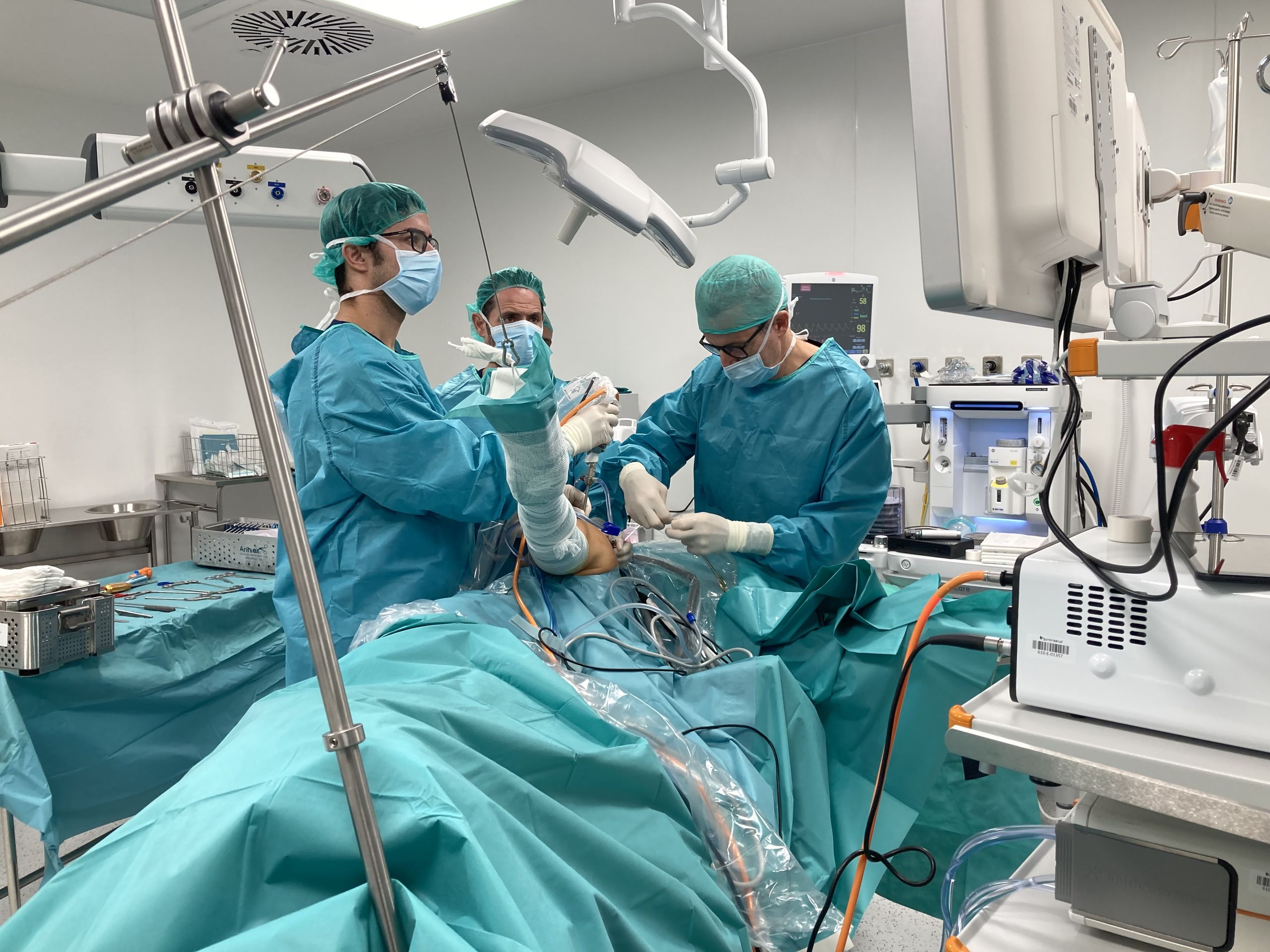
Moment of a surgical intervention in one of the Olympia rooms. | Olympia Quirónsalud
Contador, his first elite athlete
Dr. Leyes emerged from anonymity in 2014 by helping Alberto Contador competed (and ended up winning) the Vuelta a España, after having treated the Pinto cyclist for the fractured tibia he suffered in the Tour de France when he fell in the tenth stage. “That year we had a lot of media coverage, but what really marked me was witnessing how elite athletes are capable of achieving authentic feats in record time. In just three weeks he competed and won the Vuelta without the fracture having fully consolidated. It was the best cyclist in the world at that time and, for us, he was our first world-class athlete patient,” recalls Dr. Leyes.
The case of Carolina Marín
The list of elite athletes on whom Dr. Leyes has operated is very extensive and one of the most famous cases in recent months is that of Carolina Marín. Last August, during the semifinals of the Olympic badminton tournament in Paris 2024, the champion from Huelva suffered a devastating injury: a rupture of the anterior cruciate ligament (ACL) and the two menisci in her right knee. Three days later she was operated on in Madrid by Manuel Leyes. Carolina was “very unlucky” because she tore her right cruciate ligament again, as had already happened in January 2019.
When referring to this case, Dr. Leyes highlights a relevant fact: “Women are much more likely than men to tear their cruciate ligament“. And he explains the reasons: “The anatomical constitution, the X-alignment of the legs and the narrower space through which the crusader passes influence. There are also hormonal factors and lower muscle tone. “Generally speaking, with the same exposure, women are about four times more likely to break their cruciate than men.”

Dr. Manuel Leyes poses for the cameras. | Olympia Quirónsalud
The most likely sports
Within sports, Dr. Leyes highlights that those most prone to cruciate rupture are “those that require turning, braking and pivoting”, such as skiing, football, basketball, handball, rugby… In In the case of basketball, the doctor remembers some words from former player Pepe Laso (father of the current Baskonia coach, Pablo Laso), ensuring that “players know where they take off, but never where they land.” “And in the NBA there are more cruciate tears than in European basketball because there is more demand, more games and more intensity,” says the specialist.
“In women’s handball we have operated with half a team. My partner in Olympia, the Dr. Cesar Floresis the doctor of the Spanish handball team: he has been with the team for 25 years, he has been in three Olympic Games and we have operated on a lot of crusaders together,” says the Galician doctor, who does not want to overlook that “another risky sport “As far as cruciate ligament rupture is concerned, it is paddle tennis, unlike tennis, which causes few ligamentous injuries.
Furthermore, the head of the Traumatology and Orthopedic Surgery service at Olympia assures that “the cruciate breaks much more frequently during the competition than in training and, within the matches, in two periods: at the beginning, which come out with great intensity , and in the end, where fatigue comes into play,” he explains to our newspaper.
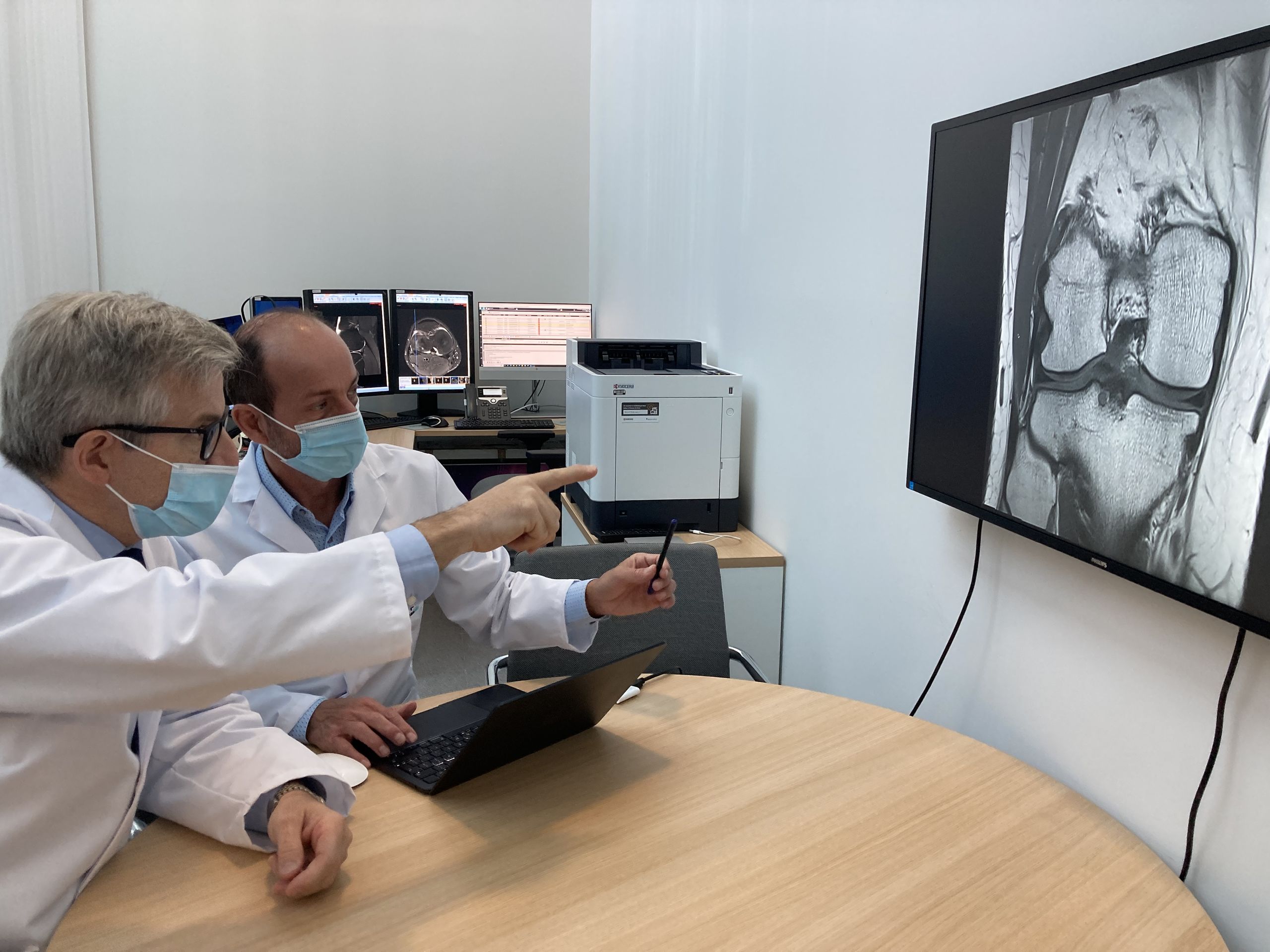
Doctors Manuel Leyes and César Flores examine a damaged knee. | Olympia Quirónsalud
Just a matter of bad luck?
Whenever an injury of this type occurs, we tend to attribute it to bad luck. This can play an important role, but there are other crucial factors that we must take into account. One of them is rest, since the risk of breaking the cruciate increases significantly in conditions of fatigue. “This is not only relevant at the time of injury, but also after surgery. After an operation, it is common for patients to achieve excellent physical condition and obtain good results in strength tests. However, upon returning to competition, it is essential that they do so progressively. For example, it is common for players, even if they are in top form, to only participate for 15-20 minutes in the second half of the match. This is because, when fatigued, their physical response is not the same as that of a player who has not suffered a similar injury, which increases the risk of relapse,” he says in this regard.
Regarding recovery times, he states that “the younger the athlete is, the longer it takes to return to competition.” “In those under 20 years of age, the tendency is to wait a year; in those who are older, they may be competing at seven or eight months“says the doctor, who also points out that “it is much more difficult for forwards to return to the level they had than for defenders because their game is based on overflow and speed” and that the return to the women’s competition is It takes longer than in the case of men.
“The rupture of the anterior cruciate ligament (ACL) not only affects the stability of the knee, but also has neurological implications. Various studies have shown that this injury can cause alterations in the cerebral cortex, especially in areas related to the motor control and proprioception. It is essential to design rehabilitation strategies that not only restore the physical function of the knee, but also optimize neuromuscular integration,” he points out.
“We have discovered that, starting from the sixth month after surgery, For each month that passes, the possibility of the plasty breaking decreases by 50%“That’s why before we were going very fast when it came to returning to the competition and now we are going slower and slower,” he adds in this regard.
Likewise, the doctor assures that around 90 percent of professional athletes who undergo surgery for a cruciate ligament injury return to competition, but only 65% of players manage to return to the sporting level they had before the injury. In a study among players from the major European leagues, three years after ACL reconstruction, 33% were competing in categories lower than those they competed in before the injury.
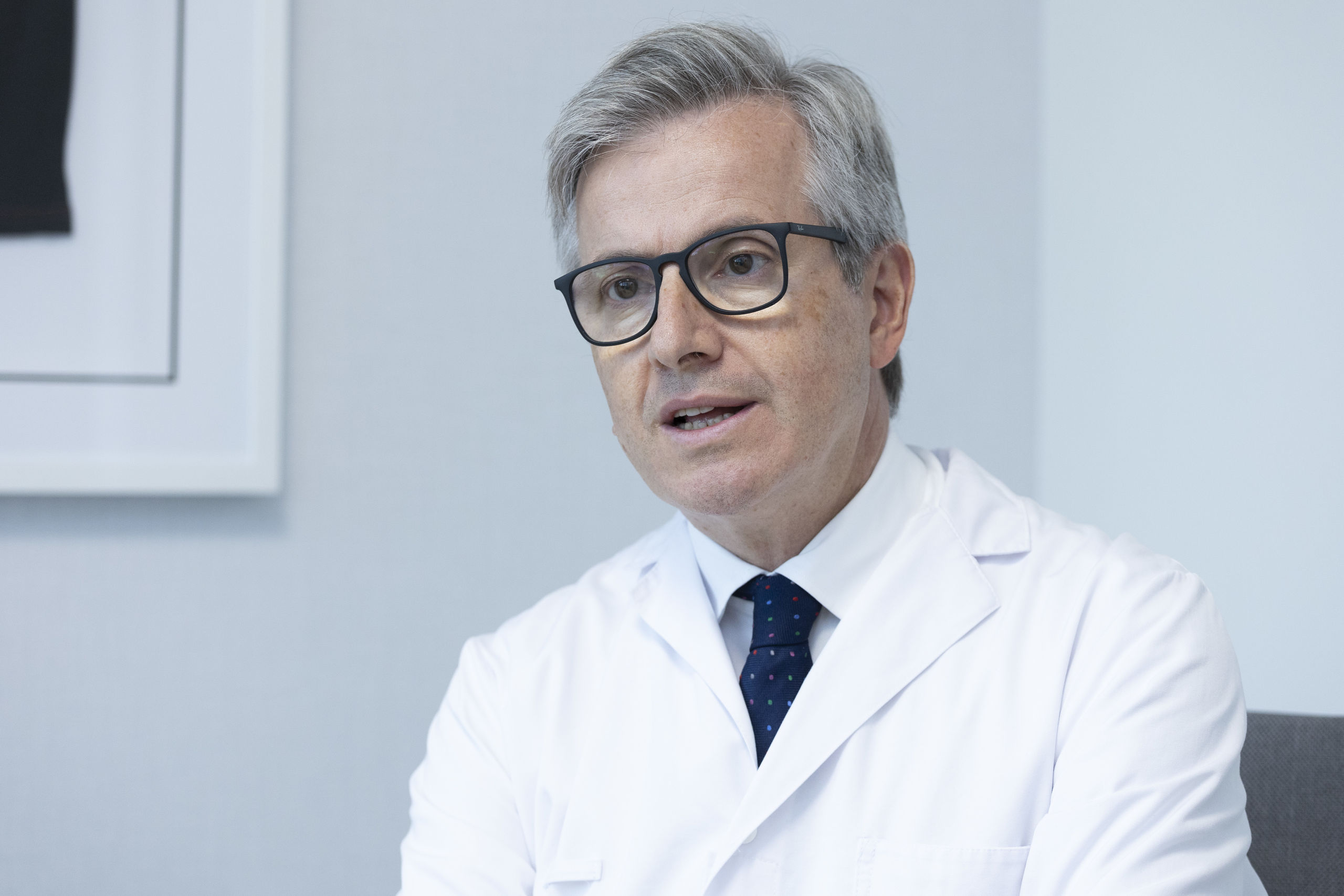
Dr. Leyes, in his office. | Olympia Quirónsalud
How to try to avoid it
Can a cruciate ligament rupture be prevented? The answer is yes, but to a certain extent. There are effective strategies to reduce the risk of this injury. Training focused on strengthening muscles, combined with proper jumping and landing techniques, is key to protecting ACL.
In fact, within football, Dr. Leyes explains that “FIFA has a prevention program, which is called FIFA 11 (FIFA 11+ for children) and that includes specific exercises to reduce the risk of breaking the cruciate, and it has been seen that it works. The players train above all how to receive jumps. The cruciate is almost always broken in the same way: the footballer remains stuck, the knee goes inward and there is a twist. The muscles that protect the cruciate ligament are the hamstrings and glutes.
In the media, the rupture of the anterior cruciate ligament (ACL) and the recovery time of athletes are frequently discussed, but the surgical process and its implications are rarely delved into. In this regard, Dr. Leyes emphasizes in LD that what really influences the complexity of the injury are the associated injuries, an aspect that often goes unnoticed in the news. “What makes recovery from an ACL tear difficult or easy are associated injurieswhich are often not mentioned in the press,” explains Dr. Leyes. “When players or clubs offer limited information, such as ‘he has torn his cruciate,’ we do not know if there is also damage to the cartilage or meniscus . “Some of these injuries, such as a complete meniscus tear, can compromise both functional and sporting results.”
The doctor gives the example of Rodri Hernandezwhom he operated on last September after suffering a cruciate tear while playing a match with Manchester City. “He came to Olympia accompanied by his club’s doctors and they were impressed, they did not expect to find a center like Olympia in Madrid. The truth is that we have managed to reverse a trend. Years ago it was common for Spanish athletes to go abroad for surgery and That is something that always caught my attention, because Spain had a very high sporting and medical level. Now. We have gotten athletes from all over the world to come to Madrid for surgery“he points out.
The public is often unaware of why a player does not return to competition after an apparently successful operation. “Many times the lack of information is due to the player himself deciding not to make it public, mainly for privacy and data protection reasons,” the specialist clarifies. These types of details are essential to understanding the true magnitude of these injuries and the challenges athletes face on their path to recovery.
Fear of relapse
“Fear is a very important factor in not recovering well,” explains Dr. Leyes. “We have a fear scale, with a QR that we pass to the athletes very shortly after operating them. This score is correlated with the return to the competitive level. If you see that this scale scores poorly, you have to start immediately with psychological work. They don’t fight for a split ball until they forget that it can be broken. As they play more games, they gain confidence and end up forgetting about the injury,” Manuel Leyes added in the interview with Digital Freedom.
2025-01-19 11:45:00